7 Wall Art Placement Rules Every Homeowner Should Know
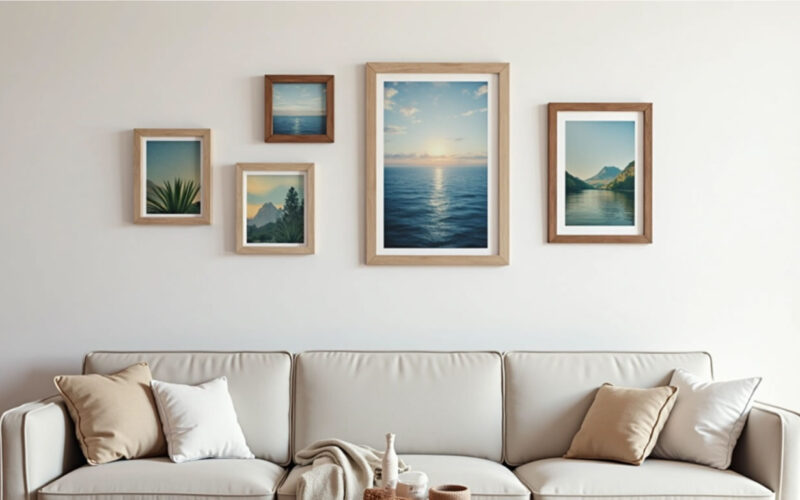
Artwork is one of the most effective ways to introduce personality, color, and texture into a home. However, even the most stunning painting or print can lose its impact if hung incorrectly. Poor wall art placement—whether hung too high, too small for the space, or awkwardly off-center—can throw off the balance of an entire room.
To elevate your home decor and showcase your collection like a professional gallery curator, keep these 7 essential wall art placement rules in mind.
1. Follow the 57-Inch Center Rule
The most common mistake homeowners make is hanging artwork too high. Galleries and museums follow a universal standard: the center of the artwork (not the top of the frame) should sit 57 to 60 inches from the floor.
This height represents the average human eye level and creates a comfortable, cohesive viewing experience throughout your home.
                           ┌────────────────────────┐
                           │      Frame Top         │
                           │                        │
  Eye Level Line ──────────┼─────── Center ─────────┼────── 57"- 60" from Floor
                           │                        │
                           │     Frame Bottom       │
                           └────────────────────────┘
                                   │
                                   │
                           ════════╧═════════ Floor
2. Anchor Art to Furniture (The 2/3 Width Rule)
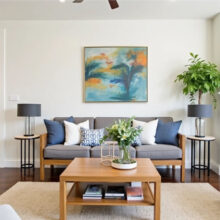
When hanging art above a piece of furniture—such as a sofa, dining sideboard, bedhead, or console table—the artwork should feel visually anchored to that piece rather than floating independently.
-
Scale: Your art piece (or group of prints) should span approximately 60% to 75% (roughly two-thirds) of the total width of the furniture below it.
-
Spacing: Hang the bottom edge of the frame 6 to 10 inches above the top of the furniture to maintain a strong visual connection.
3. Treat Gallery Walls as One Unified Piece
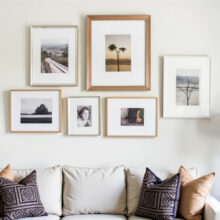
If you are grouping multiple frames together to create a gallery wall, treat the entire arrangement as a single large artwork.
-
Overall Scale: The total footprint of the gallery collection should follow the same 2/3 width rule relative to nearby furniture.
-
Consistent Spacing: Keep a uniform distance of 2 to 3 inches between each frame. If the frames are spaced too far apart, the collection will feel disconnected.
4. Scale Artwork to the Wall Space
Always match the size of your artwork to the size of the wall segment you are decorating:
-
Large, Blank Walls: Require a large-format statement piece or a multi-panel triptych to prevent the space from feeling empty.
-
Narrow Wall Sections: Small architectural niches, spaces between windows, or narrow hallway segments are perfect for vertical stacks of two or three smaller framed prints.
5. Match Eye Level for Vertical Stacks and Grids
When hanging a vertical series of two or three art pieces:
-
Determine the central focal point of the entire stack (the midpoint between the top of the upper frame and the bottom of the lower frame).
-
Align that overall midpoint with the 57 to 60-inch eye-level line on the wall.
-
Keep 2 to 4 inches of space between stacked frames to maintain breathing room.
6. Account for Architectural Features and Sightlines
Consider how the room is viewed from different angles and transitions:
-
Staircases: Follow the angle of the incline. Measure 57 to 60 inches up from every third step to create a smooth, diagonal gallery line that moves with the stairs.
-
Proximity to Molding: Avoid placing frames too close to door frames, window trims, or light switches. Leave at least 3 to 4 inches of clearance from any architectural boundary.
7. Illuminate Artwork Thoughtfully
Great placement is incomplete without proper lighting. Ensure your artwork stands out by integrating ambient or accent lighting nearby:
-
Picture Lights: Mount a dedicated LED picture light 2 to 3 inches above large frames for a dramatic, high-end gallery effect.
-
Avoid Direct Sunlight: Never hang valuable canvas paintings or delicate prints in direct sunlight, as UV rays will fade colors over time.
Wall Art Placement Cheat Sheet
| Placement Scenario | Key Rule to Remember | Recommended Distance |
| Blank Wall (Standing View) | Center of frame to floor | 57 to 60 inches |
| Above Furniture (Sofa/Console) | Bottom of frame to furniture top | 6 to 10 inches |
| Art Width vs. Furniture Width | Proportion of furniture width covered | 60% to 75% (Two-thirds) |
| Between Gallery Frames | Gap between individual frames | 2 to 3 inches |