How to Decorate a Long, Narrow Hallway
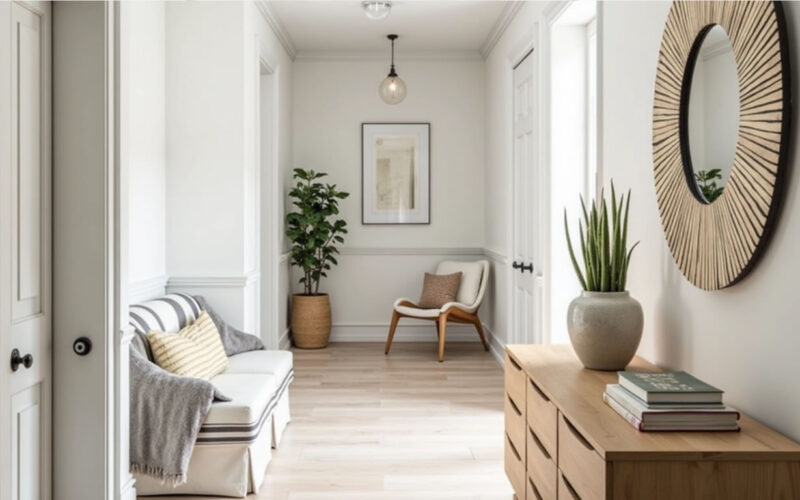
A long, narrow hallway is one of the trickiest spaces to decorate. Often referred to as a “bowling alley,” this high-traffic zone can easily feel dark, claustrophobic, and purely utilitarian. However, with the right combination of visual tricks, focal points, lighting, and purposeful decor, you can transform a pass-through corridor into a stunning, expansive gallery.
Here is how to break up the length and add depth, warmth, and style to a narrow hallway.
1. Break Up the Length with a Hallway Runner
Unbroken floor space emphasizes the extreme length of a long corridor. A runner rug softens acoustics, adds tactile warmth, and visually breaks up the linear stretch.
-
Leave Floor Borders: Ensure the runner leaves 4 to 6 inches of bare floor visible on both sides so the hallway doesn’t look like it has wall-to-wall carpeting.
-
Use Multiple Runners for Extra-Long Spaces: If your hallway is exceptionally long, use two or three matching or complementary shorter runners with a gap of visible flooring between them instead of one endless rug. This creates distinct visual “zones.”
-
Horizontal Patterns: Choose rugs with horizontal or diagonal geometric patterns to trick the eye into perceiving a wider floor footprint.
┌────────────────────────────────────────────────────────────────────────┐
│                        NARROW HALLWAY DESIGN PLAN                      │
│                                                                        │
│   ┌────────────────────────────────────────────────────────────────┐   │
│   │                      END-WALL STATEMENT ART                    │   │
│   │                 (Pulls the eye down the corridor)              │   │
│   └───────────────────────────────┬────────────────────────────────┘   │
│                                   │                                    │
│   ┌───────────────────────────────▼────────────────────────────────┐   │
│   │                ONE-SIDE GALLERY WALL / MIRRORS                 │   │
│   │       (Keeps opposite wall clean to preserve walkway depth)    │   │
│   └───────────────────────────────┬────────────────────────────────┘   │
│                                   │                                    │
│   ┌───────────────────────────────▼────────────────────────────────┐   │
│   │                  LOW-PROFILE BOARD & BATTEN                    │   │
│   │              (Adds lower-half architectural width)             │   │
│   └───────────────────────────────┬────────────────────────────────┘   │
│                                   │                                    │
│   ┌───────────────────────────────▼────────────────────────────────┐   │
│   │                     HORIZONTAL PATTERN RUNNER                  │   │
│   └────────────────────────────────────────────────────────────────┘   │
└────────────────────────────────────────────────────────────────────────┘
2. Create a Focal Point at the End Wall
When walking down a narrow hallway, your eyes naturally fixate on the far wall. Turning that end wall into a dramatic destination reduces the feeling of walking through an endless tunnel.
-
Bold Accent Color: Paint the far end wall a shade or two darker than the side walls, or use a vibrant wallpaper. Darker colors on the end wall visually pull it forward, making the hall feel wider and less stretched out.
-
Large Statement Artwork: Hang a single, large-scale piece of art or a statement mirror centered on the end wall to draw the eye directly down the center axis.
3. Implement the “One-Side Only” Gallery Wall Rule
Hanging heavy picture frames on both sides of a narrow corridor can make you feel boxed in as you walk through.
-
Choose One Main Wall: Hang your gallery wall, framed photos, or artwork on one side of the hallway only. Leave the opposite wall largely clear or style it with a single, ultra-slender mirror.
-
Uniform Framing: Use matching frame colors and mats to keep the arrangement clean and cohesive rather than chaotic.
-
Shallow Profiles: Choose slim frames that sit flush against the drywall so shoulders don’t catch on them when passing by.
4. Expand the Space with Board and Batten or Two-Tone Paint
Dividing the height of a hallway horizontally is a classic interior design technique that expands spatial perception.
-
Two-Tone Paint Line: Paint the bottom third of the wall a slightly deeper or richer color and the top two-thirds a crisp, reflective off-white or light neutral.
-
Wainscoting or Beadboard: Install board-and-batten or beadboard up to waist height ($3\text{ to }4\text{ feet}$). The horizontal chair rail breaks up vertical monotony and adds rich architectural character while protecting lower walls from scuffs.
5. Layer Overlap Light Fixtures (Ditch the Single Ceiling Bulb)
Poorly lit hallways feel tight and ominous. Layering light along the entire run makes the corridor feel open and airy.
-
Flush-Mount / Semi-Flush Series: Install a repeating series of stylish, low-profile flush-mount ceiling lights down the length of the hall rather than relying on one central fixture.
-
Wall Sconces: If your hallway is wide enough (at least $36\text{ to }42\text{ inches}$), install slender wall-mounted sconces that cast light both upward and downward to bounce off the ceiling and floor.
-
Warm Bulb Temps: Keep bulb color temperatures at 2700K to 3000K for a warm, welcoming glow.
6. Stick to Ultra-Shallow Furniture (If Any)
Standard consoles ($12\text{ to }18\text{ inches}$ deep) will choke a narrow hallway, blocking walkways and creating safety hazards.
-
Ultra-Slim Picture Ledges: Use shallow $3\text{-inch}$ floating picture ledges instead of tables to display framed prints and small decor.
-
Wall-Mounted Floating Shelves: If you need a landing surface for keys, mount a $6\text{-to-}8\text{-inch}$ floating shelf with rounded corners near the entrance zone of the hall.
Long, Narrow Hallway Styling Cheat Sheet
| Design Element | Recommended Strategy | Why It Works |
| Rug / Runner | Multiple shorter runners or horizontal patterns | Breaks up length and adds horizontal width |
| End Wall | Dark accent paint, wallpaper, or statement art | Visually pulls the far wall closer |
| Wall Decor | One-sided gallery wall with shallow frames | Prevents claustrophobia while adding personality |
| Lighting | Repeating series of flush-mounts or sconces | Eliminates dark shadows along the entire corridor |
| Wall Paint/Trim | Two-tone paint or chair-rail wainscoting | Breaks up vertical height and adds depth |