How to Choose and Hang Curtains to Make Your Ceilings Look Higher
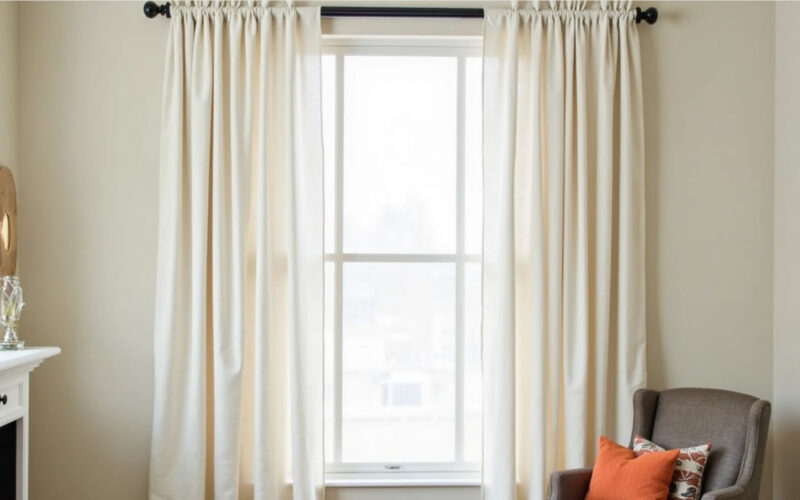
Window treatments are one of the most effective visual tools in interior design. Hung incorrectly, curtains can make a room feel short, boxy, and cramped. However, with the right placement, length, and fabric, you can instantly create the optical illusion of soaring ceilings and grander window proportions.
Here is how to choose and hang window curtains like a professional to maximize vertical height.
1. The High-and-Wide Hardware Rule
The most common window styling mistake is mounting curtain rods directly on top of the window frame. This truncates the room and cuts off visual height.
-
Mount Close to the Ceiling or Trim: Position your curtain rod $4\text{ to }6\text{ inches}$ above the top window frame, or just $2\text{ to }3\text{ inches}$ below the ceiling line/crown molding. Drawing the eye all the way up to the highest point stretches the perceived wall height.
-
Extend the Rod Width: Extend the curtain rod $8\text{ to }12\text{ inches}$ beyond the window frame on each side. When opened, the curtain panels will stack against the wall rather than covering the glass, making the window itself look dramatically wider while letting in maximum natural light.
┌────────────────────────────────────────────────────────────────────────┐
│                        WINDOW CURTAIN PLACEMENT                        │
│                                                                        │
│   ══════════════════════════════════════════════════════════════════   │
│   CEILING / CROWN MOLDING LINE                                         │
│                                                                        │
│      ┌──────────────────────────────────────────────────────────┐      │
│      │                  CURTAIN ROD (MOUNT HIGH)                │      │
│      └──────┬────────────────────────────────────────────┬──────┘      │
│             │                                            │             │
│   ┌─────────▼────────┐                          ┌────────▼─────────┐   │
│   │                 │                          │                  │   │
│   │                 │   ┌──────────────────┐   │                  │   │
│   │                 │   │                  │   │                  │   │
│   │     STACKED     │   │   WINDOW GLASS   │   │     STACKED      │   │
│   │     CURTAIN     │   │                  │   │     CURTAIN      │   │
│   │      PANEL      │   │                  │   │      PANEL       │   │
│   │                 │   └──────────────────┘   │                  │   │
│   │                 │                          │                  │   │
│   └─────────┬───────┘                          └────────┬─────────┘   │
│             │                                           │             │
│   ══════════▼═══════════════════════════════════════════▼══════════   │
│   FLOOR LEVEL (PUDDLE OR KISS THE FLOOR)                               │
└────────────────────────────────────────────────────────────────────────┘
2. Perfect Floor-Length Hemlines (Avoid High-Waters)
Short curtains that end at the window sill or hover several inches above the floor visually chop the wall in half. To maximize vertical height, long panels must extend all the way down to the flooring surface.
-
The “Kiss” (Recommended): The hem of the curtain panel lightly grazes or sits $\frac{1}{2}\text{ inch}$ above the floor. This creates a tailored, clean line that draws the eye seamlessly from ceiling to floor.
-
The “Puddle”: The fabric extends $1\text{ to }3\text{ inches}$ onto the floor, pooling softly. This offers a romantic, luxurious look, best suited for formal spaces or low-traffic rooms.
3. Choose Lightweight, Flowing Fabrics
Heavy, rigid drapery can block light and feel bulky when stacked on either side of a window. Lightweight, flowing materials create smooth, uninterrupted vertical lines.
-
Linen & Sheer Blends: Slubbed linen or semi-sheer cotton blends diffuse natural light softly while maintaining a light, airy feel that lifts the room visually.
-
Vertical Texture or Subtle Stripes: If choosing patterned curtains, look for vertical weave textures or subtle vertical stripes to subtly reinforce the upward visual flow.
4. Hardware and Header Choices
The structural details of your curtain rod and hanging mechanism play a key role in maintaining clean, vertical lines.
-
Slender Curtain Rods: Opt for thin, sturdy metal rods (in matte black, warm brass, or brushed bronze) with low-profile finials so the focus remains on the vertical drapery folds.
-
Back-Tab or Pinch-Pleat Headers: Avoid wide grommet rings, which can look casual and clunky. Instead, choose back-tab, rod-pocket, or tailored pinch-pleat headers that create structured, vertical folds from top to bottom.
Ceiling-Elevating Curtain Cheat Sheet
| Styling Factor | Incorrect Approach | Correct Height-Boosting Approach |
| Rod Height | Right on top of the window frame | $2\text{–}3\text{“}$ below ceiling / crown molding |
| Rod Width | Same width as the window frame | Extends $8\text{–}12\text{“}$ wider on each side |
| Curtain Length | Hovers $2\text{–}6\text{“}$ above the floor | “Kissing” the floor or puddle ($1\text{–}2\text{“}$) |
| Fabric Type | Stiff, heavy, or dark synthetic blockouts | Lightweight linen blends or semi-sheers |
| Header Style | Standard large metal grommets | Tailored pinch-pleat or clean back-tabs |
By mounting your hardware high and wide, choosing floor-grazing hem lengths, and using light, structured fabrics, you can easily trick the eye and make your ceilings look substantially higher.